

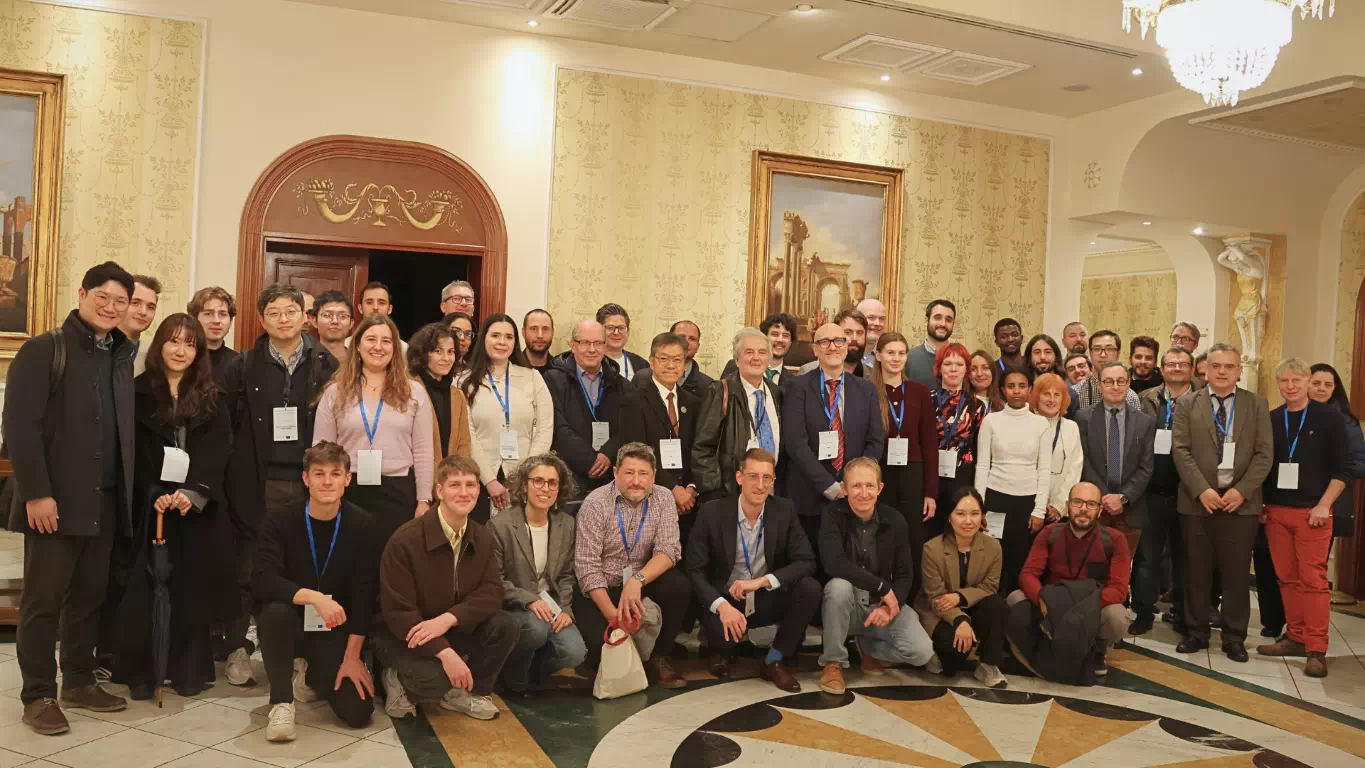
The EASI-SMR Workshop, held in Bologna, Italy, brought together over 80 participants from Europe and beyond to discuss key challenges related to scaling approaches for Small Modular Reactor (SMR) safety demonstration.
The workshop opened with the coordinator of the project, Nicolas Sobecki (EDF), who introduced the Horizon Euratom EASI-SMR project and outlined its objectives. The first technical session focused on SMR-specific phenomenology, with Fulvio Mascari (ENEA) highlighting the growing role of passive systems in SMR safety, the associated phenomenology and the need for experimental data and code Verification and Validation (V&V). This was followed by Franck Morin (CEA), who presented the SMR specific phenomenology addressed in the EASI-SMR project. Francesco D’Auria (UNIPI) then set the scene with an overview of scaling methodologies, providing a common framework for the discussions.
In the second part of the day, Pierre Gaillard (Framatome) addressed the role of scaled experiments in system code validation and licensing, while Jose Reyes (NuScale) shared insights from the U.S. experience and evolution of scaling analysis methods. The day concluded with remarks from Angelgiorgio Iorizzo (European Commission), emphasising the importance of collaboration and knowledge sharing at the European level.
The workshop continued with international perspectives on thermal-hydraulic scaling, including experience from Japan presented by Hideo Nakamura (JAEA) and South Korea presented by Chul-Hwa Song (KAERI). Further contributions were provided by representatives of companies developing experimental facilities involved in the project, who shared their companies’ experience in scaling, namely Simon Schollenberger (Framatome), Roberta Ferri (SIET), Vesa Riikonen and Joonas Telkkä (LUT), Domenico Paladino (PSI), and David Batek (UJV). Advanced methods for assessing distortions were then presented by by Sofia Carnevali (CEA), Paul Dené and Alexandre Richard (EDF).
Finally, two panel discussions explored how to move from experiment to prototype, focusing on scaling strategies, distortion management, uncertainties, and the role of simulation codes in SMR safety demonstration.
Key takeaways
Scaling remains a critical aspects for SMR safety analysis
Passive systems raise specific questions regarding distortions and uncertainties
Combining experiments, modelling, and international experience is essential
Dialogue and collaboration are key to accelerating the licensing of SMRs and their rapid deployment in Europe
The visit to SIET facilities on the last day of the workshop allowed the participants to observe the reality of test facility design, construction and test operation challenges with scaling being one of them.
The workshop also welcomed a group of students, early-career researchers and professionals, whose participation was enabled by the Mobility Fund of the European Commission ENEN2plus project, which strengthened knowledge exchange across the nuclear education and research community.
The Bologna workshop highlighted the value of shared expertise in supporting safe and innovative SMR development.